Apply on your state's official service portal (often called e-District) or at a government service centre. The revenue officer for your area, usually the tahsildar or SDM, checks the details and signs the certificate. Once it's approved, you download or print it from the same portal with your application number or login. Validity is set by each state, and the office asking for it may have its own rule, so check the date printed on the certificate and ask that office what they accept. Use only sites ending in .gov.in or .nic.in.
Start from your state's official portal
These six portals were checked on 4 November 2026. Other states have their own; search for your state's name with "e-District" and make sure the address ends in .gov.in or .nic.in before you sign in.
| State | Portal | What we saw on it |
|---|---|---|
| Bihar | RTPS service portal (serviceonline.bihar.gov.in) | Lists "Issuance of Income Certificate" as an online service |
| Delhi | e-District Delhi (edistrict.delhigovt.nic.in) | Apply online or at a Citizen Service Centre; the Revenue Department publishes the document list |
| Karnataka | Nadakacheri (nadakacheri.karnataka.gov.in) | Apply online, print the approved certificate from the site, and check any certificate on its verification page |
| Kerala | e-District Kerala (edistrict.kerala.gov.in) | Has a certificate verification page |
| Maharashtra | Aaple Sarkar (aaplesarkar.mahaonline.gov.in) | Lists Income Certificate under the state's Right to Public Services Act, with a page to verify a certificate |
| Uttar Pradesh | e-District UP (edistrict.up.gov.in) | Has application status and certificate verification |
How to apply and download, step by step
The screens differ by state, but the steps are much the same. This is how Karnataka's Nadakacheri service describes it on the Tumakuru district page:
- Register or sign in on the state portal and choose the income certificate service.
- Fill in the form and upload the documents it asks for. Pay the fee online. On Nadakacheri it is Rs 15.
- A village accountant or revenue inspector checks your details, sometimes with a visit.
- The officer, a deputy tahsildar on Nadakacheri, signs the certificate digitally or rejects it with a reason.
- Once it's approved, download or print the certificate from the portal. Nadakacheri has a "print certificates" link for this.
You can usually apply at a service centre or the tahsildar office instead. Tumakuru's page gives about 21 days for a paper application made at the tahsildar office.
Documents you'll usually need
Each state publishes its own list. Delhi's Revenue Department guidelines for income certificates are a typical example:
- Proof of identity, such as Aadhaar, PAN, voter ID, passport or driving licence
- Proof of present and permanent address, such as Aadhaar, a ration card, a bank passbook or an electricity bill
- Proof of family income, such as salary slips, where they apply
- Proof of spending, such as electricity bills, children's school fees or rent receipts
- A signed self-declaration
- A colour passport-size photo
- An earlier income certificate, if you have one (not mandatory)
Delhi's guidelines also say that some documents may need to be checked in person even if you apply online. More on Delhi's process is on the North West Delhi district page.
How long an income certificate stays valid
There is no national rule. Each state decides, and the office that asks for the certificate (a college, a scholarship or a scheme) may want one issued recently or for a particular financial year. To find out how long yours lasts:
- Read the certificate. Many show a validity line or date, and that is the date to go by.
- Ask the office that wants it. Its form or notice usually says which certificates it accepts.
- If neither tells you, ask on your state's portal or at the tahsildar office.
One example of how a state states it: the Tumakuru district page for Karnataka's Nadakacheri service says an income certificate is "valid up to a period of 12 months from date of issue". Don't assume another state follows the same rule. Check your state.
Check a certificate is genuine
Several states let anyone check a certificate online, which helps if a college or employer asks whether yours is real. Karnataka has a Nadakacheri certificate verification page, and the Kerala, Maharashtra and Uttar Pradesh portals in the table above have their own verification pages.
Watch out for look-alike sites and agents
Some private websites copy the look of government portals, or charge a fee to "make" or "download" an income certificate for you. Only the state's revenue officer can issue one, and the official portals take the fee themselves. Before you type an Aadhaar number, an OTP or a payment detail, check that the address ends in .gov.in or .nic.in. If someone offers to get you a certificate without the usual checks, don't use it.
Save it with its validity date, and get a reminder
We make DocIt, so keep that in mind as you read this part. DocIt is an Android app for keeping documents on your phone. It has no link to any state government, tahsildar or service portal, and it can't apply for or issue a certificate.
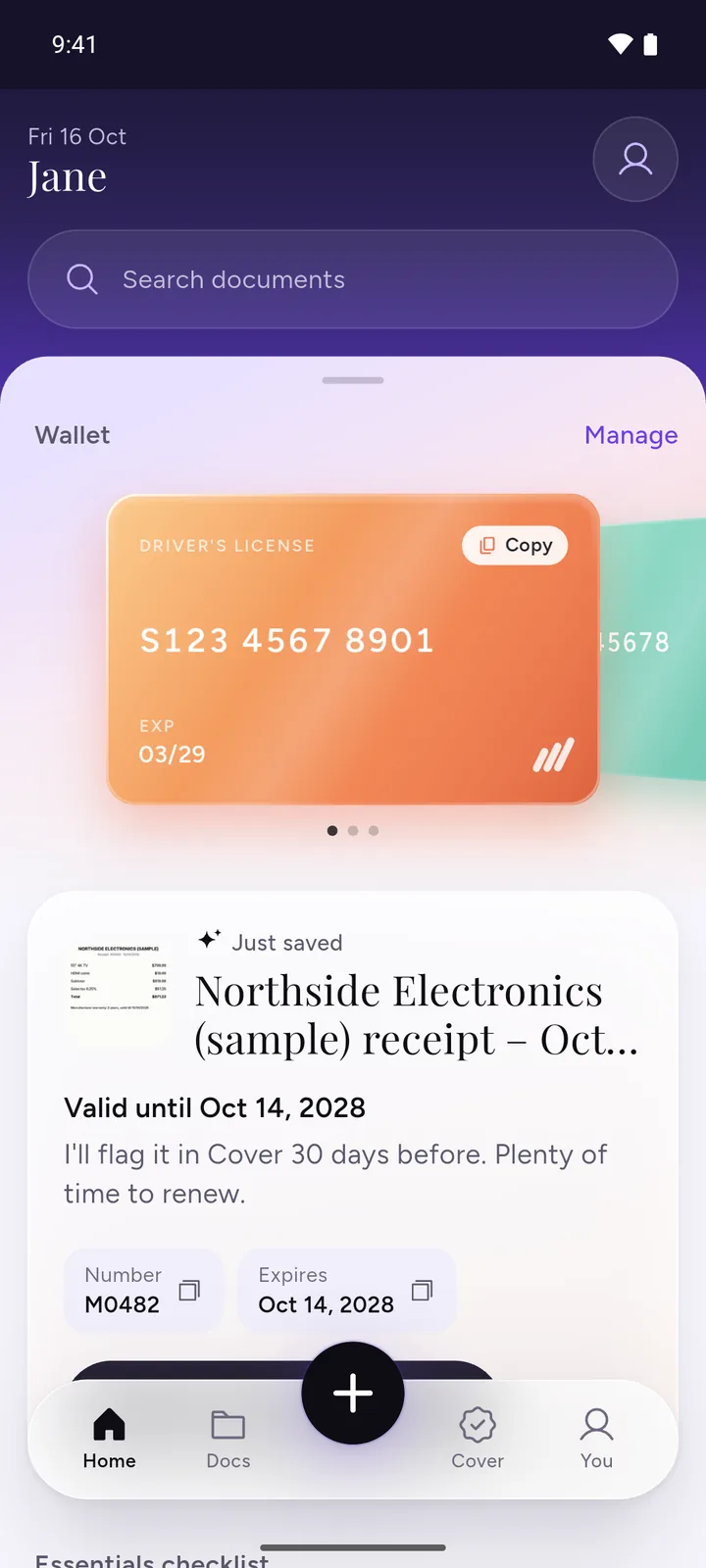
DocIt keeps a copy on your phone of the certificate you already have:
- Import the PDF you downloaded, or scan a paper certificate.
- Enter the validity date as the expiry date. DocIt can suggest one from the page, and you check it before saving. DocIt doesn't know your state's rule; the date is the one you enter.
- Turn on reminders and DocIt reminds you 30, 7 and 1 day before that date, so you can apply for a fresh certificate in time. More on how that works in document expiry reminders.
- When a scholarship or admission form has an upload limit, make a copy under 100 KB, 200 KB, 500 KB or 1 MB. In the smaller copy the text becomes part of the page picture, so keep the original too.
A copy in DocIt is for convenience only. It isn't valid as the original certificate: offices that need it will check the certificate issued by your state. Files are encrypted on your phone. DocIt is free on Google Play, on Android.
Questions
How long is an income certificate valid?
There is no single rule for India. Each state sets its own, and the office that asks for the certificate may want one issued recently or for a particular year. Look for a validity line or date printed on your certificate, and ask the office that wants it what they accept. As one example, the Tumakuru district page for Karnataka's Nadakacheri service says an income certificate is "valid up to a period of 12 months from date of issue".
Who issues an income certificate?
The state government, through its revenue officers: usually the tahsildar, deputy tahsildar or SDM for your area. You apply on the state's service portal or at a service centre, and the certificate is signed by that officer.
Can I download an income certificate I already have?
Usually yes, from the same portal you applied on, using your application number or your login. Karnataka's Nadakacheri site, for example, has a "print certificates" option once the certificate is approved. If you applied at a counter, ask that office how to get a copy.
Is a downloaded, digitally signed income certificate valid?
A certificate issued and digitally signed by the state's officer is the real certificate. Several states let anyone check it on a verification page. A photo or scan you made of it is only your own copy.
What if the office wants a specific format?
Some schemes and colleges name a particular certificate or format in their notice. Read that notice first and apply for the certificate it names, so you do not have to apply twice.
Is DocIt connected to the e-District portals?
No. DocIt is a document app. It isn't linked to any state government or service portal, and it can't apply for or issue a certificate.
Related
- Birth certificate download in India: get the digital copy
- Aadhaar card download: e-Aadhaar, password and PVC card
- Compress a PDF to 200 KB
- Important documents checklist
How we checked: the portals and process above were read on the official state and district sites linked on this page on 4 November 2026. The document list comes from the Delhi Revenue Department's guidelines, and the steps, fee and validity example from the Tumakuru district page for Karnataka. The DocIt part was checked against the app's feature list for version 2.4.4. This page explains the process; it isn't legal advice and doesn't tell you whether you qualify for any scheme.