Keep the originals that are hard to replace, such as birth and marriage certificates, property deeds, car titles and your will, together in one safe place. Keep anything you may need in a hurry, like passports and powers of attorney, at home rather than in a bank box. Put copies of the key documents in a grab-and-go kit and on your phone. Then tell one person you trust where everything is.
Last checked 17 October 2026 against Ready.gov (FEMA), the FDIC, GOV.UK, the Government of Canada and the Australian Red Cross. The "original or copy" column is our own suggestion.
The checklist
Not every household has every item. Go through it once, tick what you have, and note where each one is.
| Area | Documents | Original or copy | Where |
|---|---|---|---|
| Identity | Passports, driver's licenses, birth certificates, citizenship or residence documents, visas, and the record of each person's Social Security, National Insurance, Social Insurance or tax file number | Keep the original | Passports and licenses where you can reach them fast; certificates with your other originals |
| Family | Marriage and divorce certificates, adoption and custody documents, death certificates of close relatives | Keep the original | With your other originals |
| Home and car | Property deed or title, mortgage or lease, car title or registration (a V5C logbook in the UK), loan agreements | Keep the original | Safe deposit box or home safe |
| Money | A list of bank, card, pension and investment accounts (no passwords), recent tax returns, pay slips and benefit letters | A copy is usually enough | Home file, plus a copy in your grab-and-go kit |
| Insurance | Health, life, home or renters, car and travel policies, and the insurers' phone numbers | A copy is usually enough | Home file, plus a copy in your kit |
| Health | Health insurance or Medicare card, a list of medicines and allergies, immunization records, your doctor's details | A copy is usually enough | In your kit and on your phone |
| Legal and wishes | Will, powers of attorney, advance care directive or living will, funeral wishes | Keep the signed original | Where your executor or attorney can get it; ask a lawyer where your will should be kept |
| Big purchases | Receipts and warranties for appliances, electronics and anything you would claim on insurance; photos or video of your home's contents | A copy is usually enough | Home file, plus scans |
The categories follow Ready.gov's list (household identification, financial and legal documents, medical information, insurance and contacts) and the Australian Red Cross's list of key documents. "Original or copy" and "Where" are our suggestions; your bank, lawyer or government may ask for something different.
Add one more page that isn't a document: a written list of phone numbers for your bank, insurers, doctor and family. The UK government's Prepare campaign suggests writing important numbers down on paper, in case your phone is lost or flat.
Keep the original, or is a copy enough?
A good rule: keep the original of anything an office may ask to see in person, or that proves who you are, who you're married to or what you own. Birth, marriage and death certificates, deeds, car titles, wills and powers of attorney fall in this group. If you lose one, replacing it can take weeks.
For most money, insurance and health documents, a copy does the job. Banks and insurers can send statements and policy documents again, and many are online already. What you need in an emergency is the account number and the phone number, fast.
Copies still matter for the originals too. The Australian Red Cross says having copies of your key documents helps you stay in control if you need to check in to an evacuation centre or apply for replacement documents.
Where to keep originals
- A home safe or lockable box. The FDIC says a home safe suits items you may need quickly, like a passport, but is not as secure as a bank's safe deposit box. Put documents in resealable, water-safe plastic bags inside it.
- A bank safe deposit box. The FDIC lists originals of key documents, such as birth certificates, property deeds and car titles, as good candidates. It says not to keep anything you might need quickly or when the bank is closed, such as passports or the originals of powers of attorney. The bank generally doesn't insure what is inside.
- With a lawyer or solicitor. For a will, GOV.UK lists your home, your solicitor, your bank, a will storage company or the national probate registry (England and Wales). In the US, the FDIC suggests asking a lawyer what your state requires.
Keep originals together, not spread over three drawers. In a fire, flood or hurry, one box is easier to find and carry than a scattered pile.
A grab-and-go copy for emergencies
Emergency advice in all four countries says to have copies of your documents ready, away from the originals:
- Canada: the Government of Canada suggests keeping copies of important documents such as birth certificates, wills, passports and insurance policies in your emergency kit, in an easy-to-reach place that everyone in the household knows about.
- Australia: the Australian Red Cross suggests copies of your key documents in one place outside your home: ID and visa documents, birth and marriage certificates, ownership documents, insurance and ongoing prescriptions.
- United States: Ready.gov suggests storing important documents in a safety deposit box, on an external drive or in the cloud.
- United Kingdom: local councils' emergency advice, such as Warrington's, lists copies of important family documents in a waterproof bag as part of a grab bag. GOV.UK's flood advice says to keep your flood plan with essential items such as important documents.
A practical kit: one waterproof folder with copies of everyone's ID, the insurance policies, the list of accounts and phone numbers, and a medicine list. A second copy on your phone means you have it even if you leave without the folder. If your copies are many separate PDFs, our free Merge PDF tool joins them into one file for an external drive or the trusted person below, without uploading them. For where on your phone, see where to keep copies of your important documents on your phone.
Tell one trusted person where everything is
The best-organised box doesn't help if nobody else knows it exists. GOV.UK says to tell your executor, or a close friend or relative, where your will is. Do the same for the rest: a partner, an adult child or a close friend should know where the originals are, where the kit is, and who your lawyer is. You don't need to give them copies of everything, just the map.
If you look after a parent's documents, ask them the same questions now, while it is easy. The day you need a parent's insurance policy is not the day to start searching for it.
How DocIt handles this
We make DocIt, so read this part with that in mind. DocIt is for the "copy on your phone" part of this checklist, not a replacement for originals.
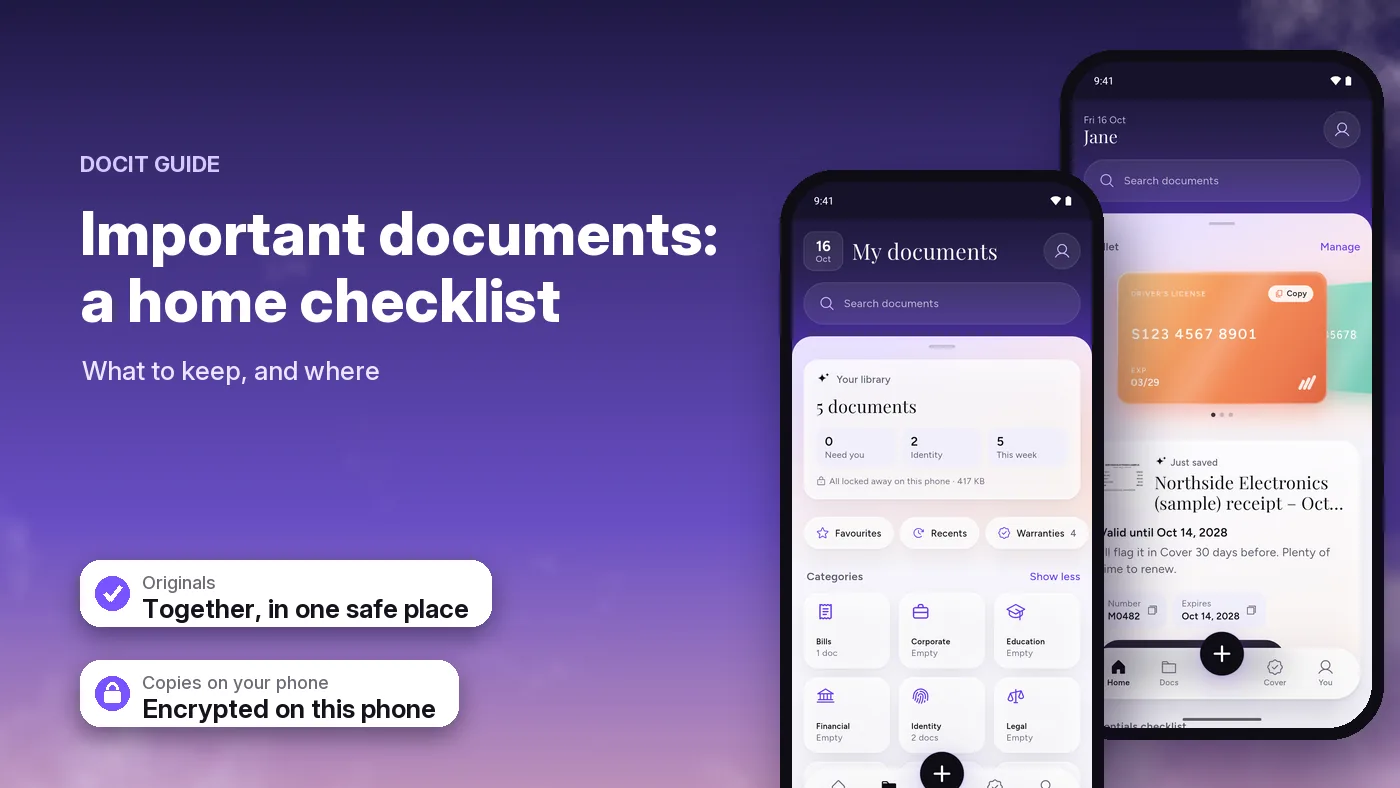
- Scan or import: scan a document with automatic edge detection and crop, or import photos and PDFs you already have. DocIt reads the document and fills in the details for you to check.
- Organised like the checklist: categories such as Identity, Financial and Legal, and your own folders up to three levels deep.
- Numbers one tap away: ID numbers in the wallet, ready to copy into a form, even offline.
- Dates watched: each document shows Valid, Expiring or Renew now. Your phone reminds you 30, 7 and 1 day before an expiry date, once you turn reminders on.
- Private: encrypted on this phone (AES-256), with an app lock using your fingerprint or PIN. No sign-up and no ads.
The honest part: copies in DocIt are not official documents, and DocIt can't share them with family on other phones. The trusted person still needs to know where the originals are. Keep a paper copy in your kit too.
DocIt is free on Google Play in the US, UK, Canada, Australia and 7 more countries, on Android only.
Where to keep copies on your phone · When to renew your passport · Your ID numbers in DocIt's wallet · How DocIt protects your documents, and its limits
Questions
Should I keep my passport in a bank safe deposit box?
The FDIC suggests not. It says anything you might need quickly, or when the bank is closed, such as a passport or the original of a power of attorney, doesn't belong in a safe deposit box. A home safe suits those better, though the FDIC notes home safes are not as secure as a bank box.
Are things in a safe deposit box insured?
Usually not by the bank. The FDIC says financial institutions generally don't insure the contents of safe deposit boxes, and FDIC deposit insurance doesn't cover them. Ask your home or renters insurer whether they can add cover.
Where should I keep my will?
In England and Wales, GOV.UK says you can keep it at home or store it with your solicitor, your bank, a will storage company or the national probate registry, and should tell your executor or a close friend or relative where it is. In the US, the FDIC suggests checking with a lawyer about what your state requires. Elsewhere, ask the lawyer who drew it up.
Is a scan or photo as good as the original?
Not for everything. A copy helps you fill in forms, prove details and replace a lost document faster, but many offices want the original or a certified copy for things like a birth certificate or a will. Keep the originals safe and use copies day to day.
How often should I check the list?
Once a year is a good habit, and whenever something changes: a move, a new car, a marriage, a new baby, or a passport or license renewal. Swap old copies for new ones so nobody grabs an expired document in a hurry.
Sources
All checked on 17 October 2026.
- Ready.gov (FEMA): financial preparedness (updated 13 March 2026)
- FDIC: five things to know about safe deposit boxes, home safes and your valuables (updated 1 August 2023)
- GOV.UK: making a will, where to keep it
- GOV.UK: prepare for flooding
- UK Government: Prepare
- Warrington Borough Council: how to prepare for an emergency (dated 21 July 2026)
- Government of Canada: making an emergency kit (modified 12 September 2025)
- Australian Red Cross: get organised