
A birth certificate comes from the registrar where the birth was registered. In 29 states, union territories and areas, births are registered on the national Civil Registration System (CRS) portal, dc.crsorgi.gov.in, run by the Office of the Registrar General of India. Elsewhere, use your state's or municipality's own service, or visit the registrar's office. Under the 2023 amendment, the registrar gives the first certificate free, within seven days of registration, electronically or on paper. Use only sites ending in .gov.in or .nic.in.
What changed in 2023
Parliament amended the Registration of Births and Deaths Act, 1969 in August 2023, and a notification of 13 September 2023 brought the changes into force on 1 October 2023. For a family, three changes matter most:
- Digital certificates. The registrar now gives the certificate "electronically or otherwise", free of charge, no later than seven days after registration (section 12).
- One record nationally. The Registrar General of India keeps a national database of registered births and deaths, and states must share their data with it (section 3).
- Proof of date and place of birth. For anyone born on or after 1 October 2023, the certificate "shall be used to prove the date and place of birth" for the purposes below (section 17(3)).
The purposes the Act lists:
- admission to a school, college or other educational institution
- a driving licence
- the voter list
- registering a marriage
- a job with the central or state government, a local body, a public sector undertaking or a statutory or autonomous body
- a passport
- an Aadhaar number
- any other purpose the central government decides
So for a child born today, the birth certificate is the document these offices will ask for. Keep it safe from the start.
Download it from the CRS portal
The CRS portal's home page says it is open for births and deaths that took place in these places only (checked 4 November 2026): Andaman and Nicobar Islands, Andhra Pradesh, Arunachal Pradesh, Assam, Bihar, Chandigarh, Chhattisgarh, Dadra and Nagar Haveli and Daman and Diu, Delhi Cantonment Board, Goa, Gujarat, Haryana, Himachal Pradesh, Jammu and Kashmir, Jharkhand, Ladakh, Lakshadweep, Madhya Pradesh, Maharashtra, Manipur, Meghalaya, Mizoram, Nagaland, Puducherry, Sikkim, Telangana (GHMC area), Tripura, Uttar Pradesh and Uttarakhand.
- Open dc.crsorgi.gov.in/crs and choose Login, then General Public.
- If you're new, sign up with your name, sex and date of birth and the other details the form asks for. Then log in with your email or mobile number.
- Follow the portal's steps to report the birth or get the certificate, then download it.
The General Public login is meant for births at home. The portal says members of the public log in "to Report events of Birth & Death and obtain certificates", and that the events "should have been occurred at Home". For a birth in a hospital, the hospital reports it to the registrar. The model rules that states base their own rules on say the family then obtains the certificate from the registrar, electronically or otherwise (model rules, 2024, rule 8). Ask the hospital which registrar it reported to, and get the certificate from that registrar's office or online service.
If your state isn't on the CRS list
Some states and cities run their own birth registration portals, and some issue certificates mainly at the counter. In that case:
- Find the registrar for the place of birth: usually the municipal corporation or municipality in a town, or the gram panchayat in a village.
- Use that body's own website or your state's official service portal. Before you type any details, check that the address ends in .gov.in or .nic.in.
- Keep the registration number if you have it. It makes the record easier to find.
Private sites offer to "download" or "make" birth certificates for a fee. You don't need one: the registrar is the only issuer, and the first certificate is free under the Act.
Late registration
If a birth wasn't reported on time, it can still be registered, but the later it is, the more steps it takes. The rules come from the 2023 amendment and the 2026 amendment, which took effect on 1 October 2026:
| Reported after the birth | What it needs |
|---|---|
| Within 30 days | Registered by the local registrar; a small late fee can apply under your state's rules if the normal period has passed |
| 30 days to 1 year | Written permission of the District Registrar, a fee and a self-attested document |
| 1 to 2 years | An order from a District Magistrate, Sub-Divisional Magistrate or authorised Executive Magistrate, after checking the facts, and a fee |
| More than 2 years | An order from a Judicial Magistrate of the first class, after checking the facts, and a fee (from 1 October 2026) |
Fees are set in each state's rules, so ask your registrar for the current amount.
Keep each family member's certificate, marked whose it is
We make DocIt, so keep that in mind as you read this part. DocIt is an Android app for keeping documents on your phone. It has no link to the Registrar General of India, any state or any municipality, and it can't register a birth or issue a certificate.
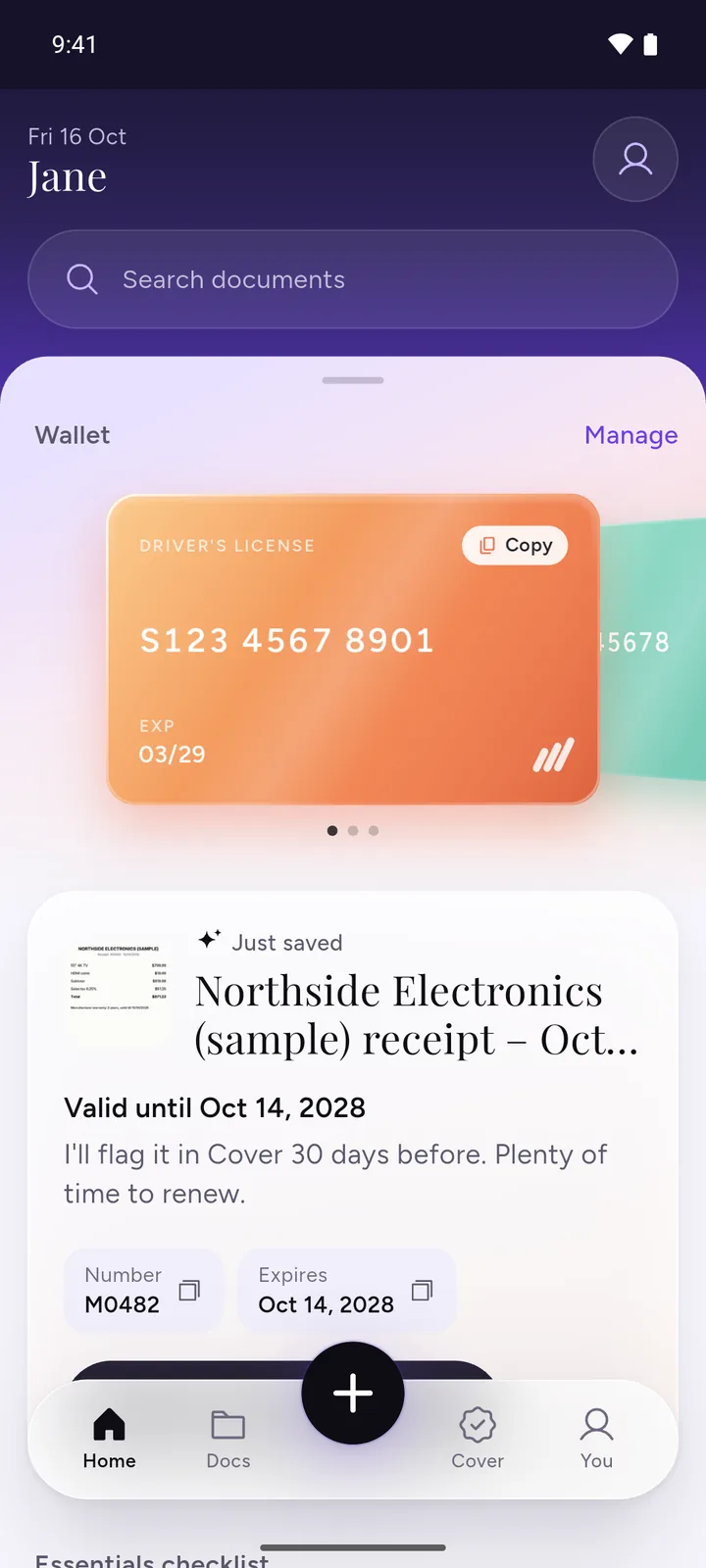
DocIt keeps a copy on your phone of the certificates you already have:
- Import the certificate PDF you downloaded, or scan a paper certificate.
- Mark whose it is, so your child's, your spouse's and your own certificates don't get mixed up. Your first family member is free; DocIt Plus adds more family members.
- When a school or passport form has an upload limit, make a copy under 100 KB, 200 KB, 500 KB or 1 MB. In the smaller copy the text becomes part of the page picture, so keep the original too.
A copy in DocIt is for convenience only. It isn't valid as the certificate itself: offices that need it will ask for the certificate issued by the registrar. A birth certificate has no expiry date, so there's nothing to remind you about. Files are encrypted on your phone. DocIt is free on Google Play, on Android.
Questions
Is the birth certificate now the only proof of date of birth?
The 2023 amendment says that for anyone born on or after 1 October 2023, the birth certificate "shall be used to prove the date and place of birth" for the purposes listed on this page, such as school admission, a passport and Aadhaar. For people born before that date, the amendment doesn't change which documents an office accepts. Check the office's own list.
Is a digital birth certificate valid?
Yes. Since the 2023 amendment, the Act says the registrar gives the certificate "electronically or otherwise". A certificate issued online by the registrar is a real certificate. A photo or scan you made of it is only your own copy.
Does a birth certificate cost money?
The first certificate after registration is free: the Act says the registrar gives it free of charge within seven days. Extra copies and late registration have fees, which each state sets in its own rules.
My state is not on the CRS list. Where do I go?
Go to the registrar where the birth was registered, usually the municipal corporation, municipality or gram panchayat, or its online service. Use only sites that end in .gov.in or .nic.in.
Can I get a birth certificate for an old birth that was never registered?
Yes, but it takes more steps. From 1 October 2026, a birth reported more than two years late needs an order from a Judicial Magistrate of the first class. Between one and two years, a District Magistrate or Sub-Divisional Magistrate can order it.
Does a birth certificate expire?
No. It records a fact, so it has no end date.
Is DocIt connected to the CRS portal?
No. DocIt is a document app. It isn't linked to the Registrar General of India, any state or any municipality, and it can't register a birth or issue a certificate.
Related
- Passport application in India: documents required
- PAN card: apply online, e-PAN, status and Aadhaar link
- Aadhaar card download: e-Aadhaar, password and PVC card
- Important documents checklist
How we checked: the rules above were read in the Registration of Births and Deaths (Amendment) Acts of 2023 and 2026, their commencement notifications and the model rules of 2024, all from the CRS portal, on 4 November 2026. The list of states and the login text come from the CRS portal itself. The DocIt part was checked against the app's feature list for version 2.4.4. This page explains the process; it isn't legal advice.