
Start with the customer information sheet (CIS), which every health insurer in India must give you: it sums up the sum insured, what is covered, the exclusions, the waiting periods and how to claim. Then check the policy wording, because that is what the insurer goes by when it decides a claim. Benefits people often forget, if their plan has them, include a free health check-up, restoration of the sum insured, cashless treatment, pre- and post-hospitalisation expenses, day-care procedures, the no-claim bonus and OPD cover.
Last checked 17 October 2026 against IRDAI's own pages, listed at the end of this page.
Where to look in your policy
A health policy is usually a bundle of documents. Each part answers a different question.
- The customer information sheet (CIS). Start here. Insurers must give one with every policy. It sums up, in simple words and in one place, the sum insured, what is covered, the main exclusions, sub-limits, deductibles, waiting periods, and how to claim and complain. You can ask for it in your local language. (IRDAI master circular, 2024)
- The policy schedule. The page or two with your details: who is covered, the sum insured, the policy period, any optional add-ons you chose, and the policy number you will need for every call.
- The policy wording. The long legal document. This is what the insurer actually goes by when it decides a claim, so it wins over any brochure or sales call.
- The benefit table. Often a table near the start or in an annexure, showing each benefit with its limit, such as a cap on room rent or a fixed amount for ambulance.
- Exclusions. What the policy does not pay for at all. Read this section slowly.
- Waiting periods. Time after the policy starts during which some diseases or treatments are not covered. Many claims are refused simply because a waiting period had not ended.
If you have just bought the policy, you get a free look period of 30 days from receiving the policy document to review the terms and cancel if you are not happy, for policies of one year or more. (IRDAI master circular, 2024)
7 benefits people forget to use
Every benefit below depends on your plan. Some plans include it, some don't, and limits vary a lot. Check your policy wording, and ask your insurer before you rely on any of them.
1. Free or preventive health check-up
Some plans pay for a health check-up every year or after a set number of claim-free years. It often goes unused because nobody remembers it is there. Look in the benefit table or the CIS for "health check-up" and note any amount limit or list of approved centres.
2. Restoration or recharge of the sum insured
Some plans refill your sum insured if it gets used up during the year, so you are not left without cover for a second illness or another family member. The rules differ: some restore it only for a different illness, some only once a year. The policy wording explains exactly when it applies.
3. Cashless treatment at network hospitals
At a network hospital, the insurer pays the hospital directly, up to the amount it pre-authorises, so you don't pay the whole bill and claim later. (IRDAI standard definitions) You need the insurer's approval first, and the hospital must be on your insurer's or TPA's network list. (IRDAI policyholder site) IRDAI asks insurers to decide a cashless request within one hour and to give final discharge approval within three hours. (IRDAI master circular, 2024)
4. Pre- and post-hospitalisation expenses
Tests, medicines and doctor visits for the same illness, in a set number of days before admission and after discharge, can be claimed if the hospital claim itself is accepted. (IRDAI standard definitions) In IRDAI's standard plan, Arogya Sanjeevani, the windows are 30 days before and 60 days after. (IRDAI FAQ) Your plan's windows may differ. Keep every bill and prescription from those weeks.
5. Day-care procedures
Some treatments that once needed more than 24 hours in hospital now take less, such as many procedures done under anaesthesia. These are called day-care treatments, and plans can cover them even though you were not admitted overnight. (IRDAI standard definitions) Insurers may limit this to a specified list, so check yours.
6. No-claim bonus
If you don't claim in a year, the insurer may reward you at renewal, either with extra sum insured at no extra premium (a cumulative bonus) or with a discount on the renewal premium. (IRDAI master circular, 2024) Check your renewal notice to confirm the bonus was added. If you switch insurers, it can move with you.
7. OPD cover (only some plans)
OPD treatment means you visit a clinic or doctor for diagnosis and treatment without being admitted. (IRDAI standard definitions) Most basic hospital plans don't pay for this. If yours does, there is usually a yearly limit, and it can cover consultations you are paying for yourself today.
Also worth checking: AYUSH and ambulance
Hospital treatment under AYUSH systems (Ayurveda, Yoga, Unani, Siddha, Homoeopathy) is covered in the standard plan, and IRDAI asks insurers to treat AYUSH on par with other treatments. (IRDAI FAQ, master circular) The standard plan also pays for an ambulance up to Rs 2,000 per hospitalisation. (IRDAI FAQ) Other plans set their own limits, so look in the benefit table.
A 20-minute check you can do today
- Find the CIS and the schedule. If you can't find them, ask your insurer to send them again.
- Make a short list. For each benefit above, write yes, no or not sure, with the page number where you found it and any limit.
- Note the dates. The renewal date, when each waiting period ends, and when a health check-up becomes due, if your plan has one.
- Save the numbers you'll need in a hurry. The policy number, the insurer's or TPA's claims helpline, and how to find the network hospital list.
- Call about anything marked "not sure". Ask the insurer to confirm in writing or by email, and keep that reply with the policy.
Do this for each family member the policy covers, because limits and waiting periods can differ from person to person.
Switching insurers without losing credit
Portability lets you move your policy to another insurer, or to another plan with the same insurer, at renewal. Apply at least 45 days before the renewal date, and renew without a break. (IRDAI policyholder site) You can carry over credit for the sum insured, no-claim bonus and waiting periods already served. (IRDAI master circular, 2024) The new insurer still decides the premium and other terms.
If a claim or complaint goes wrong
- Complain to the insurer first. Write to its grievance officer with copies of your documents and get a dated acknowledgement. The insurer should resolve it within two weeks. (IRDAI policyholder site)
- Escalate to IRDAI through Bima Bharosa. If the insurer doesn't resolve it or you are not satisfied, register the complaint on the Bima Bharosa portal. It does not ask complainants for any payment. You can also call 155255 or 1800 4254 732. (IRDAI policyholder site)
- Go to the Insurance Ombudsman. If the insurer rejects your complaint, doesn't reply within a month, or you are unhappy with its answer, you can complain to the Ombudsman within one year. It charges no fee. (Council for Insurance Ombudsmen) The insurer's reply to your grievance must include the Ombudsman's contact details. (IRDAI master circular, 2024)
At every step, note the date, the name of the person you dealt with and the reference number.
How DocIt helps
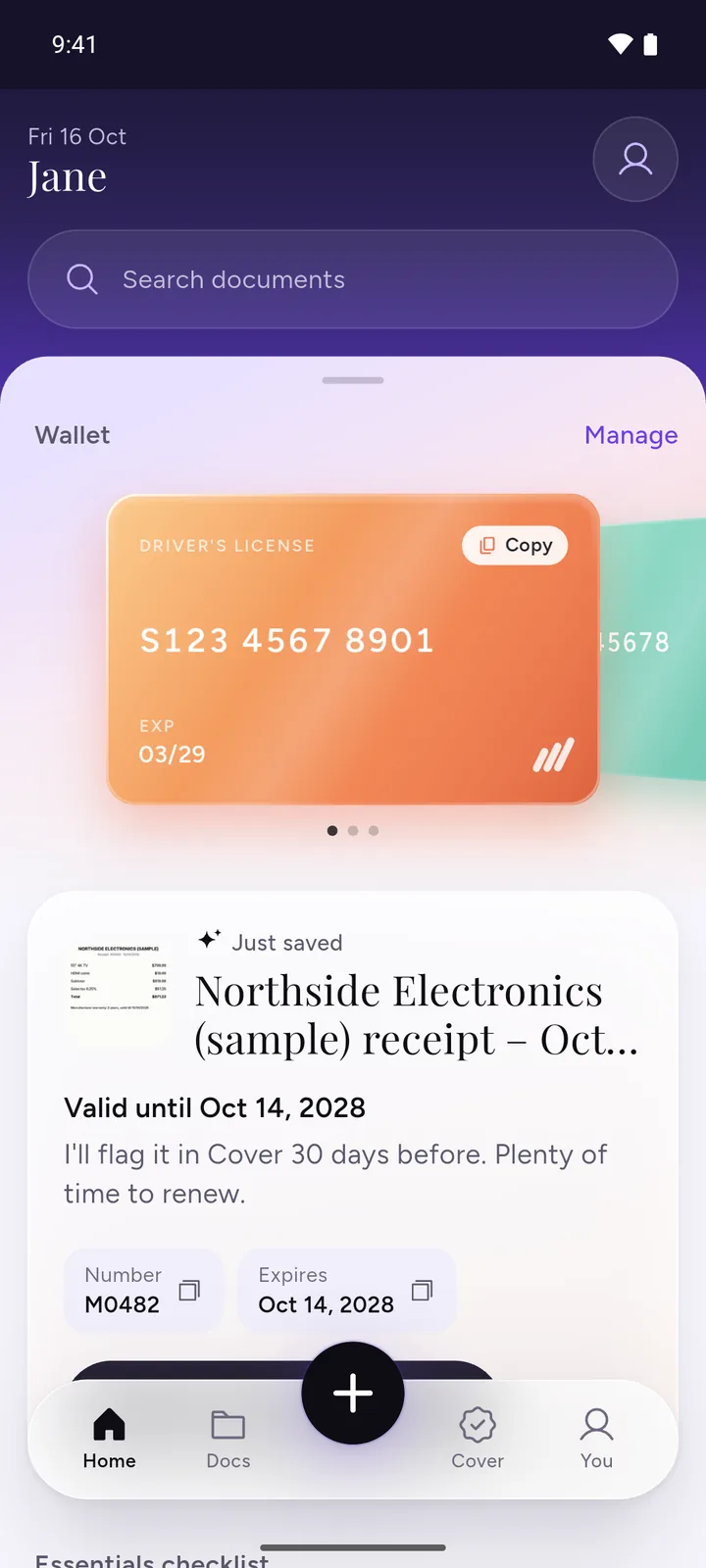
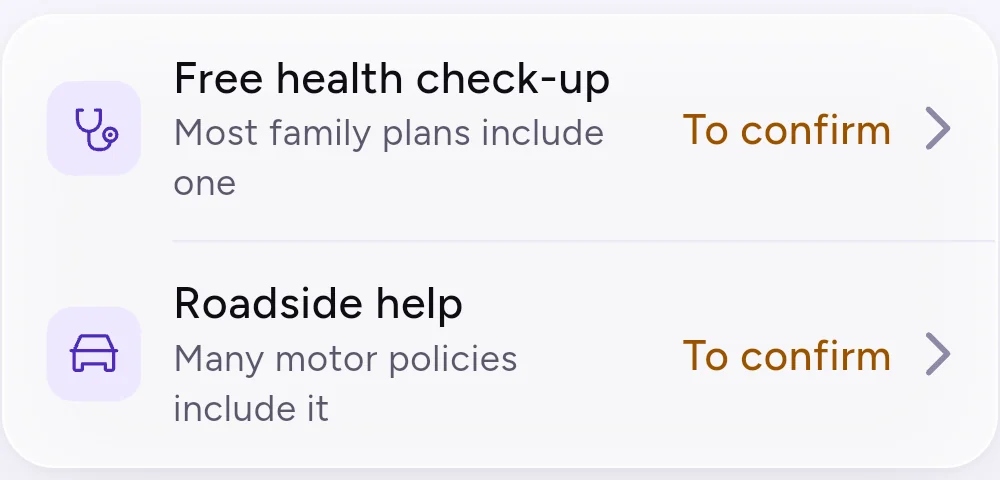
Once you save a health or motor insurance policy and mark it as a policy, DocIt shows common benefits from a fixed set: free health check-up, restoration of the sum insured, cashless treatment, OPD cover, roadside assistance, no-claim bonus and air-accident cover. On a policy of more than one page, each one shows the page number it came from, so you can check that page in the wording yourself. It looks for these common benefits only, so it won't catch everything a policy offers.
Each policy also shows Valid, Expiring or Renew now, so you can see at a glance when it ends. Turn reminders on and DocIt reminds you on your phone 30, 7 and 1 day before the end date.
DocIt is free to download on Google Play, on Android only.
See what your policy covers with DocIt · Important documents checklist · Car documents in India · Where to keep your important documents on your phone
Sources
- IRDAI: Master Circular on Health Insurance Business, 29 May 2024 (PDF)
- IRDAI: Guidelines on Standardization in Health Insurance, standard definitions (PDF)
- IRDAI: FAQs on the standard health product, Arogya Sanjeevani
- IRDAI policyholder site: how to make a health claim
- IRDAI policyholder site: portability of health insurance
- IRDAI policyholder site: how to make a complaint
- Bima Bharosa (IRDAI grievance portal)
- Council for Insurance Ombudsmen