When you drive a private car in India, carry your driving licence, the registration certificate (RC), the insurance certificate and a valid PUC certificate. A 2018 transport ministry advisory asks states to treat copies issued into DigiLocker or mParivahan like the originals, but a photo or scan you saved yourself doesn't count. Each document has its own end date: a private car's RC lasts 15 years, a licence's validity depends on your age, and the insurance and PUC certificates show their end dates on them.
Last checked 17 October 2026 against MoRTH, Parivahan, DigiLocker and IRDAI sources listed at the end of this page.
What to carry when you drive
Under the Motor Vehicles Act, 1988 and the Central Motor Vehicles Rules, 1989, the owner or driver has to show the licence, the certificate of registration and other documents to an authorised officer when asked. IRDAI's policyholder site lists the same set to keep in the vehicle. For a private car, keep these with you:
- Driving licence. Yours, for the kind of vehicle you are driving.
- Registration certificate (RC). Proof that the car is registered, and in whose name. If the car is on a loan, the RC also shows the bank's hypothecation entry.
- Insurance certificate. Third party liability cover is compulsory for every vehicle used on public roads. IRDAI's policyholder site calls this "Liability Only" or "Act Only" cover. A comprehensive or package policy adds cover for damage to your own car.
- Pollution Under Control (PUC) certificate. Issued after an emission test at an authorised centre. Test results are now uploaded to the national vehicle database, VAHAN.
Taxis, goods vehicles and other transport vehicles carry more: a permit and a fitness certificate. Parivahan explains the main permit types, and asks transport vehicles for fitness and permit clearances before an NOC is issued. The type of permit and its conditions depend on the vehicle and the state.
Digital copies that count, and ones that don't
On 8 August 2018 the Ministry of Road Transport and Highways wrote to every state transport department and traffic police chief about this. The advisory says documents in DigiLocker or the mParivahan app "are deemed to be legally recognised at par with the original documents as per the provisions of the Information Technology Act, 2000". It asks states to treat them as valid under the Motor Vehicles Act, "at par with the certificates issued by the transport authorities".
Three points from that advisory are worth knowing:
- Insurance shows up on its own. Insurance data for new and renewed policies is uploaded to VAHAN daily and appears in mParivahan and eChallan. If the record shows a policy in force, the advisory says the officer should not insist on a paper copy.
- No physical seizure. If an offence needs a document impounded, the officer can record it electronically through eChallan instead of taking the paper.
- It is an advisory to states. Enforcement is done by each state, so practice can differ.
The key word is "issued". The DigiLocker rules let departments accept documents "at par with the physical documents" when the issuer has pushed them into your DigiLocker account. A photo in your gallery, a PDF on WhatsApp or a scan you uploaded yourself is not the same thing. Pull your licence and RC into DigiLocker or mParivahan from the official source, and check they open before you leave.
How long each document lasts
Driving licence
Since the 2019 amendment to the Motor Vehicles Act, a private (non-transport) licence lasts according to your age on the day it is issued or renewed:
- Under 30: valid until you turn 40.
- 30 to 49: valid for 10 years.
- 50 to 54: valid until you turn 60.
- 55 and over: valid for 5 years.
A licence to drive transport vehicles lasts five years. The same amendment lets you apply for renewal up to one year before the expiry date. If you apply more than a year after it lapses, the licensing authority will make you pass the driving test again. Renewal is done through Sarathi, the licence services portal, and the forms and fees vary by state. Parivahan's own renewal page still shows the older, shorter time limits, so confirm the current rule with your state before you leave it late.
Registration certificate
Under section 41 of the Motor Vehicles Act, the RC of a private car is valid for 15 years from the date of issue. After that it has to be renewed to keep using the car. Parivahan says to apply in Form 25, not more than 60 days before the expiry date, to the registering authority where the vehicle is. Clear any pending road tax and expect to show a PUC certificate. Parivahan's tax FAQ notes that private vehicle tax is usually paid once for 15 years and then again at each five-year renewal. Since 2019, the Act lets the central government set different renewal periods for different types of vehicle, so check the current period with your RTO.
Insurance
For a new private car, IRDAI says you can buy either a bundled policy or a long-term liability only policy, with third party cover for three years. An annual package or annual liability only policy is not allowed for a new car. In a bundled policy the own damage part lasts one year and needs renewing every year, while the third party part runs for the full three years. After that, most owners renew yearly. IRDAI suggests contacting your insurer at least 15 days before the policy ends, and says a valid PUC certificate is mandatory on the date you renew.
PUC certificate
Every PUC certificate has a validity date printed on it. Check that date, not the day you got tested, and keep it current all year. You need a valid one to renew insurance and for most RTO work, including RC renewal, a duplicate RC and NOCs. You can look up your latest certificate on the Parivahan PUC portal.
Rules can vary by state. Fees, forms, and whether you need to visit the office or can finish online all depend on the state transport department. Treat this page as a starting point and check your state's details on Parivahan.
What to keep at home
These don't travel with you, but you will want them when you sell the car, claim insurance, or deal with the RTO:
- Purchase invoice and the dealer's documents. Useful for insurance claims and for resale.
- Service records and the warranty booklet. A full service history helps a warranty claim and supports the price when you sell.
- All your insurance policies, not just the current one. When you switch insurer, IRDAI says you prove your No Claim Bonus with a renewal notice or a letter from the previous insurer.
- Loan closure documents. When you repay a car loan, the bank's entry on the RC does not disappear by itself. Get the bank's NOC (no objection certificate, or due clearance certificate) and apply to remove the hypothecation in Form 35, signed by you and the financier. Parivahan calls this "HP termination". Until it is done, the RC still shows the bank.
- Tax receipts and old RCs from previous renewals or transfers.
If something expires or goes missing
- Licence expired: renew on Sarathi. Within a year of expiry it is a normal renewal; after that, expect a retest.
- Licence lost or damaged: apply for a duplicate licence in Form 2 through Sarathi. Parivahan asks for attested photocopies of the old licence if you have them.
- RC lost or stolen: report it at the police station where it happened, inform the registering authority in writing, and apply for a duplicate RC in Form 26 on Vahan. Parivahan lists a police certificate as one of the documents needed after loss or theft.
- RC due for renewal: apply in Form 25 within the 60 days before expiry.
- Insurance lapsed: renew before you drive again. Third party cover is compulsory on public roads.
- PUC lapsed: get the car tested at an authorised PUC centre.
If a Sarathi form asks for your photo, Sarathi's own upload guide (as of 19 October 2026) asks for a JPG between 10 and 20 KB, preferably 420 x 525 pixels. Our free resize image tool sets the pixel size in your browser, without uploading the photo.
How DocIt helps
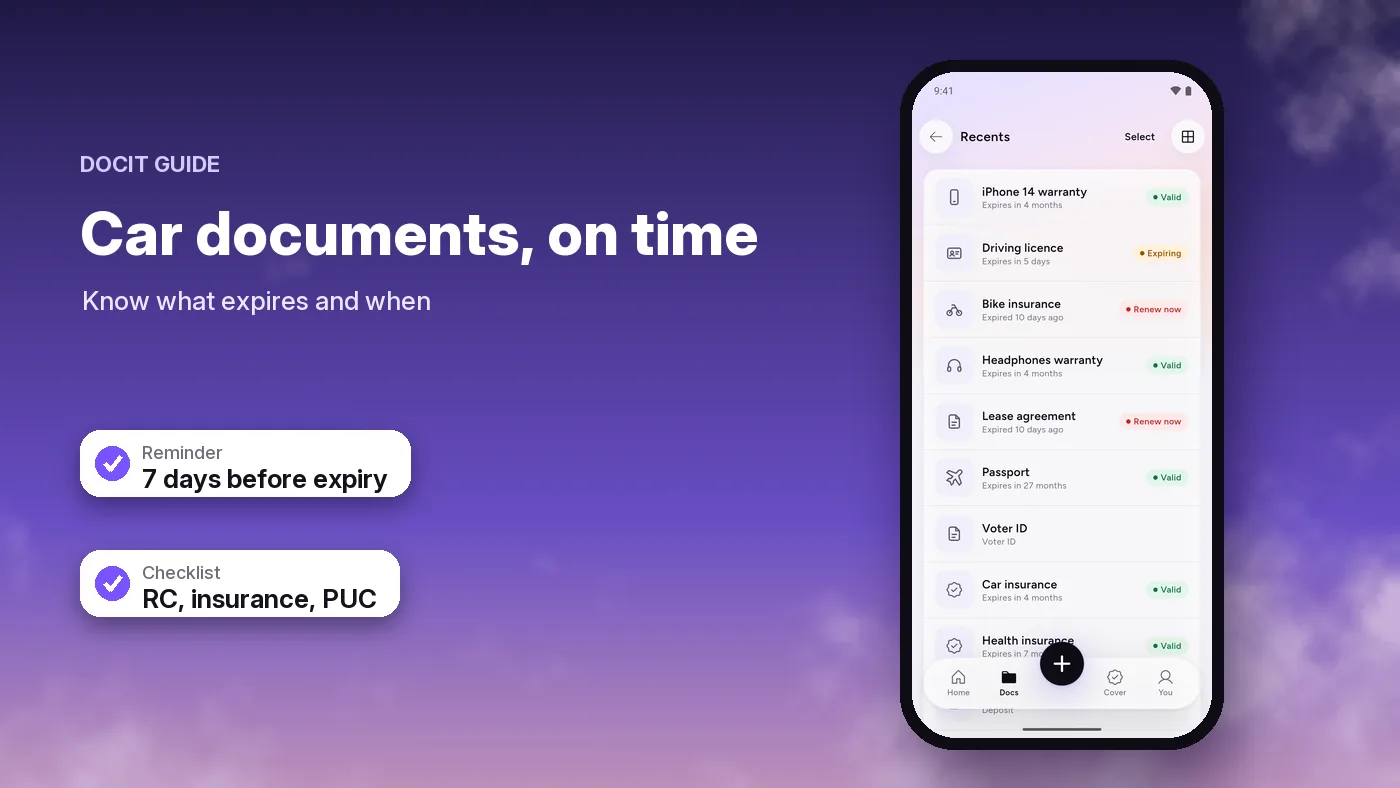
DocIt's Essentials checklist includes your RC, vehicle insurance and PUC certificate. Once a date is read from the document or you type it in, each one shows Valid, Expiring or Renew now. When you turn reminders on, your phone reminds you 30 days, 7 days and 1 day before it expires. These are notifications on your phone, and you don't need to sign in.
Many motor policies print the dates as "Period of insurance: From … To …". DocIt reads the end date from that layout and suggests it when you save. Check the expiry date it fills in before you tap Save.
Copies saved in DocIt are not official documents. When you need to show a document, carry the original or an official digital copy from DigiLocker or mParivahan.
DocIt is free on Google Play in India and 10 more countries, on Android only.
DigiLocker and DocIt: what each is for · Lost your wallet? The order to act in · Important documents checklist · Where to keep your important documents on your phone · Know what your insurance policy covers
Sources
- MoRTH advisory, 8 August 2018: acceptance of documents presented through DigiLocker or mParivahan (PDF)
- The Motor Vehicles (Amendment) Act, 2019, Gazette of India (PDF)
- MoRTH G.S.R. 527(E): PUC results uploaded to the vehicle register (PDF)
- DigiLocker rules and amendment, rule 9A (PDF)
- Parivahan: renewal of driving licence (shows the pre-2019 time limits)
- Parivahan: renewal of registration certificate
- Parivahan: duplicate RC
- Parivahan: duplicate licence
- Parivahan: HP termination (removing hypothecation)
- Parivahan: about permits
- Parivahan: FAQ
- Sarathi: driving licence services
- Sarathi: photo and signature scan and upload guide (PDF, checked 19 October 2026)
- Vahan: vehicle registration services
- Parivahan PUC portal
- IRDAI Policyholder: motor insurance FAQs