
For central government jobs and central admissions, the EWS certificate is the Income and Asset Certificate in the format the Department of Personnel and Training (DoPT) set in its office memorandum of 31 January 2019. It is issued by a revenue officer of your state, not below the rank of Tehsildar, after checking your documents. It is based on the family's income for the financial year before the year you apply, and it has a "Valid for the year" field. Delhi, for example, treats it as valid only for the financial year in which it was issued. Apply through your state's revenue office or its official portal.
What the EWS certificate is
In January 2019 the central government provided 10% reservation for Economically Weaker Sections (EWS) in central civil posts and services and in admission to educational institutions. The DoPT memorandum of 19 January 2019 quotes the Ministry of Social Justice and Empowerment's order on this. A second DoPT memorandum, of 31 January 2019, set out the details for direct recruitment, including the certificate. Both are reproduced in full in this Government of Puducherry order of 5 March 2019, which forwarded them to its departments.
The memorandum says the benefit "can be availed upon production of an Income and Asset Certificate issued by a Competent Authority". In short, the certificate records the officer's finding, after checking your documents, on two things:
- Family income for the previous financial year, against the limit set in the memorandum.
- Assets the family owns, such as agricultural land or residential property, against the limits set in the memorandum.
It also states that the applicant's caste is not recognised as a Scheduled Caste, Scheduled Tribe or Other Backward Class in the central list. The exact limits and the meaning of "family" are in paragraph 4 of the 31 January memorandum. Whether you qualify is for the issuing officer to decide, so read the memorandum yourself and ask the office if you're unsure. This page doesn't judge eligibility.
This page covers the central format. For state government jobs and state college seats, a state can have its own EWS rules and certificate. The issuing office will tell you which one it is giving you.
Who issues it
Paragraph 5.1 of the 31 January 2019 memorandum says a certificate in the Annexure-I format, issued by any one of these officers, "shall only be accepted" as proof:
- District Magistrate, Additional District Magistrate, Collector, Deputy Commissioner, Additional Deputy Commissioner, 1st Class Stipendiary Magistrate, Sub-Divisional Magistrate, Taluka Magistrate, Executive Magistrate or Extra Assistant Commissioner
- Chief Presidency Magistrate, Additional Chief Presidency Magistrate or Presidency Magistrate
- a Revenue Officer not below the rank of Tehsildar
- the Sub-Divisional Officer of the area where the candidate or their family normally lives
The officer issues it "after carefully verifying all relevant documents following due process as prescribed by the respective State/UT". So the office you visit, and the steps, depend on where you live. Two examples:
- Delhi: the area Sub-Divisional Magistrate (SDM) issues it, and you apply online only, on the Delhi e-District portal. The Revenue Department's order says the certificate is issued online within 15 days of a complete application.
- Puducherry: the Tahsildar, or a Deputy Tahsildar who is also an Executive Magistrate, issues it after a field enquiry, according to the Revenue Department's instructions.
What is on the certificate
The Annexure-I format is titled "Income & Asset Certificate to be produced by Economically Weaker Sections". These are the fields that matter when you keep it:
| Field | What it tells you |
|---|---|
| Certificate number and date | Lets the office that receives it check it with the officer who issued it |
| "Valid for the year" | The year the certificate is meant to be used for |
| "For the financial year" | The year whose family income the certificate is based on |
| Applicant details and attested photo | Name, parent or spouse, permanent address, with a recent passport size photo |
| Signature and seal | The name and designation of the officer who issued it |
The two year fields are easy to mix up. "For the financial year" is the year of income that was checked. "Valid for the year" is the year you can use the certificate in.
How long it is valid
The central memorandum doesn't give a fixed period in its text. Instead, the format has a "Valid for the year" field that the officer fills in. The certificate is based on the family's income "for the financial year prior to the year of application" (31 January memorandum, paragraph 4.1).
Delhi's Revenue Department says a certificate "shall be valid only for the financial year in which it has been issued". Its example is an application made in May 2019: it is decided on 2018-19 income, and the certificate "shall remain valid only till 31st March, 2020" (Delhi order, paragraph 4.12).
Other states may word this differently, so read the date on your own certificate. Then check what the job or admission notice asks for. For central recruitment, the memorandum says the crucial date for the certificate is normally the closing date for applications, unless the notice fixes another date (paragraph 5.3). If you're selected, the appointing office checks your certificate with the officer who issued it before the appointment is final (paragraph 5.4).
How to apply
The steps differ by state, but most follow this pattern:
- Find your state's official service portal (often called e-District) or your tehsil, taluk or SDM office. Check the address ends in .gov.in or .nic.in.
- Choose the EWS or Income and Asset Certificate service. Read the list of documents the portal asks for. These usually cover identity, address, family income and property.
- Fill in the form and upload the documents. Note the application number.
- The revenue office checks the details, sometimes with a field visit, and the officer signs the certificate.
- Download or collect the certificate. Check your name, the two year fields and the officer's seal straight away.
Give correct information. The Delhi order says a certificate obtained on false information can be cancelled, and the central memorandum says an appointment based on a false claim will be ended.
Watch out for look-alike sites and agents
Some private websites copy the look of government portals, or charge a fee to "make", "renew" or "download" an EWS certificate for you. Only the revenue officers listed above can issue one, and the official portals take any fee themselves. Before you type an Aadhaar number, an OTP or a payment detail, check that the address ends in .gov.in or .nic.in. If anyone offers you a certificate without the usual document check, don't use it.
Save it with its validity date, and get a reminder
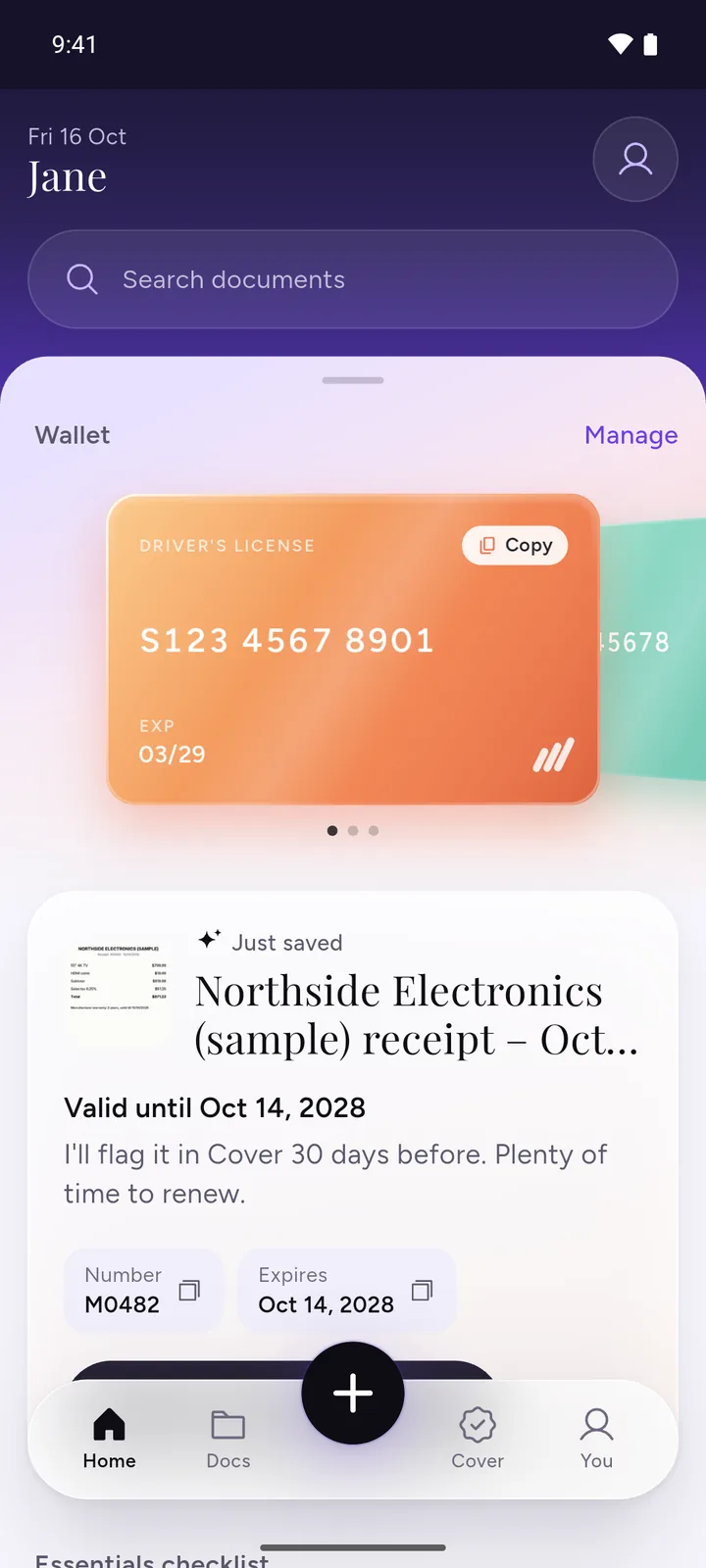
We make DocIt, so keep that in mind as you read this part. DocIt is an Android app for keeping documents on your phone. It isn't a government app. It has no link to the DoPT, any state government, tehsil, SDM or e-District portal, and it can't apply for, issue or check a certificate.
DocIt keeps a copy on your phone of the certificate you already have:
- Import the certificate PDF you downloaded, or scan the paper certificate.
- Enter the last day of the "Valid for the year" period as the expiry date. DocIt doesn't know your state's rule; the date is the one you enter.
- Turn on reminders and DocIt reminds you 30, 7 and 1 day before that date, so you can apply for the next year's certificate before an admission or recruitment round. More in document expiry reminders.
- When an application form has an upload limit, make a copy under 100 KB, 200 KB, 500 KB or 1 MB. In the smaller copy the text becomes part of the page picture, so keep the original too.
DocIt keeps a copy on your phone for convenience; it is not valid as the original. Offices that need the certificate will check the one issued by the revenue officer. Files are encrypted on your phone. DocIt is free on Google Play, on Android.
Questions
What is the official name of the EWS certificate?
The central format is called the "Income & Asset Certificate to be produced by Economically Weaker Sections". It is Annexure-I of the Department of Personnel and Training office memorandum of 31 January 2019.
How long is an EWS certificate valid?
The central format has a "Valid for the year" field, so the certificate itself says which year it is for. Delhi's Revenue Department, for example, says a certificate is valid only for the financial year in which it was issued. Check the date on yours and the rule of the office you are applying to.
Which year's income does the certificate use?
The income of the financial year before the year you apply, from all sources: salary, agriculture, business, profession and so on. That is how the 31 January 2019 memorandum puts it.
Do I need a new certificate every year?
Usually yes, because each certificate names one year. If a job or admission notice asks for a certificate for a particular year, a certificate for an older year may not be accepted. Read the notice.
Can I use my state EWS certificate for a central government job?
For central posts, the memorandum says only a certificate in the Annexure-I format, issued by one of the listed officers, is accepted. Some states issue a separate certificate for state posts. Ask the issuing office which one you are getting.
Where do I apply?
At your state or union territory's revenue office, or on its official online service portal where it has one. Delhi, for example, takes applications only on its e-District portal. Use only sites ending in .gov.in or .nic.in.
Is DocIt a government app?
No. DocIt is a document app. It isn't linked to the Department of Personnel and Training, any state government or any revenue office, and it can't apply for, issue or check a certificate.
Related
- Birth certificate download in India: get the digital copy
- PAN card: apply online, e-PAN, status and Aadhaar link
- Compress a PDF to 100 KB for an upload form
- Important documents checklist
How we checked: the rules above were read on 4 November 2026 in the DoPT office memorandums of 19 and 31 January 2019 (as reproduced in the Government of Puducherry order of 5 March 2019, because the copy on dopt.gov.in did not load that day), the Puducherry Revenue Department's instructions and the Delhi Revenue Department's order on issuing the certificate. The DocIt part was checked against the app's feature list for version 2.4.4. This page explains the process; it isn't legal advice, and it doesn't say who qualifies. Check with your issuing office.