You get a domicile certificate from the revenue office of the state you live in: usually the tehsildar, taluk office or SDM, and often through the state's online service portal. You'll need proof of identity, proof of address, proof of date of birth and proof of how long you've lived there. In Delhi, for example, you show 3 years of continuous stay, pay no fee, and the certificate is issued in 14 days. Rules, names and fees differ by state, so check your state's portal first.
What a domicile certificate is
It's a certificate from a state government that says you live in that state. There is no single national format: each state decides who can get one, what it's called and how long it lasts. You'll usually be asked for it when a form gives a benefit to people who live in a particular state, such as an admission or job form. The form or notice says which certificate it accepts.
The name matters. Kerala's e-District portal lists domicile, nativity and residence certificates as three different services. Uttar Pradesh issues a residence (nivas) certificate. If a form names one of these, apply for that one.
How four states handle it
As their official pages read on 5 November 2026:
| State | Where to apply | Worth knowing |
|---|---|---|
| Delhi | SDM of your area, or the Deputy Commissioner's office. Online too. | No fee. Issued in 14 days. |
| Kerala | Taluk office or village office, through e-District. | Valid for life, per the e-District FAQ. |
| Uttar Pradesh | e-District, at a CSC or Lokvani centre. Called a residence (nivas) certificate. | Aadhaar number is mandatory. |
| Maharashtra | Aaple Sarkar portal, as the "Age Nationality Domicile" certificate. | Check the portal for documents and fee. |
Sources: Delhi Department of Revenue, Kerala e-District FAQ, e-District Uttar Pradesh and Aaple Sarkar, Maharashtra. For other states, look for the domicile or residence certificate on the state's e-District or service portal.
Documents you'll usually need
Delhi
The Department of Revenue asks for:
- the application form, self attested
- an Aadhaar number, or if you don't have one, a PAN card, passport, driving licence or voter card
- a self declaration in the set format (a parent signs it for a child under 18)
- proof of your present address, such as a voter card or an electricity, water or telephone bill
- proof of date of birth: a birth certificate, school certificate or passport
- proof that you have lived in Delhi without a break for the last 3 years, such as school records, electricity bills, house tax or water bills
- the phone number and ID card copy of the class I gazetted officer who attested your form
Delhi says all documents need to be attested by a gazetted officer, and your photo is taken by web camera when you apply or at verification. It should match the photo on your Aadhaar.
Kerala
Kerala's e-District FAQ lists these supporting documents for a domicile certificate: Aadhaar card, an affidavit, birth certificate, election ID card, an ID proof, ration card and the school certificate of your parents. The certificate is issued by the taluk office or village office.
Uttar Pradesh
The e-District site says an Aadhaar number is mandatory for caste, income and residence certificates. You hand in the filled form with a passport size photo, a self declaration and copies of supporting documents at a CSC or Lokvani centre. Missing documents at verification can get the application rejected.
Step by step
- Find your state's service portal. Search for your state's name with "e-District", or start from the revenue department's website. Check the address ends in .gov.in or .nic.in.
- Pick the right certificate: domicile, residence or nativity, whichever your form asks for.
- Gather the documents your state lists. Proof of how long you've lived in the state is the one people most often miss.
- Apply online, at a service centre or at the tehsil or SDM office. Note the application number.
- Answer any field check. Many states verify your address before they approve.
- Download or collect the certificate. Check your name, parent's name, address and date before you use it.
Watch out for look-alike sites and agents
Some private websites look like state portals, or charge a fee to "make" a domicile certificate fast. Only the state's revenue authority can issue one, after its own checks. Before you type an Aadhaar number, an OTP or a payment detail, check that the address ends in .gov.in or .nic.in. If a service centre charges you, ask for a receipt that shows the official fee. A certificate that skips the state's verification isn't a real one.
Keep it ready for the next form
We make DocIt, so keep that in mind as you read this part. DocIt is an Android app for keeping documents on your phone. It has no link to any state government or service portal, and it can't issue or verify a certificate.
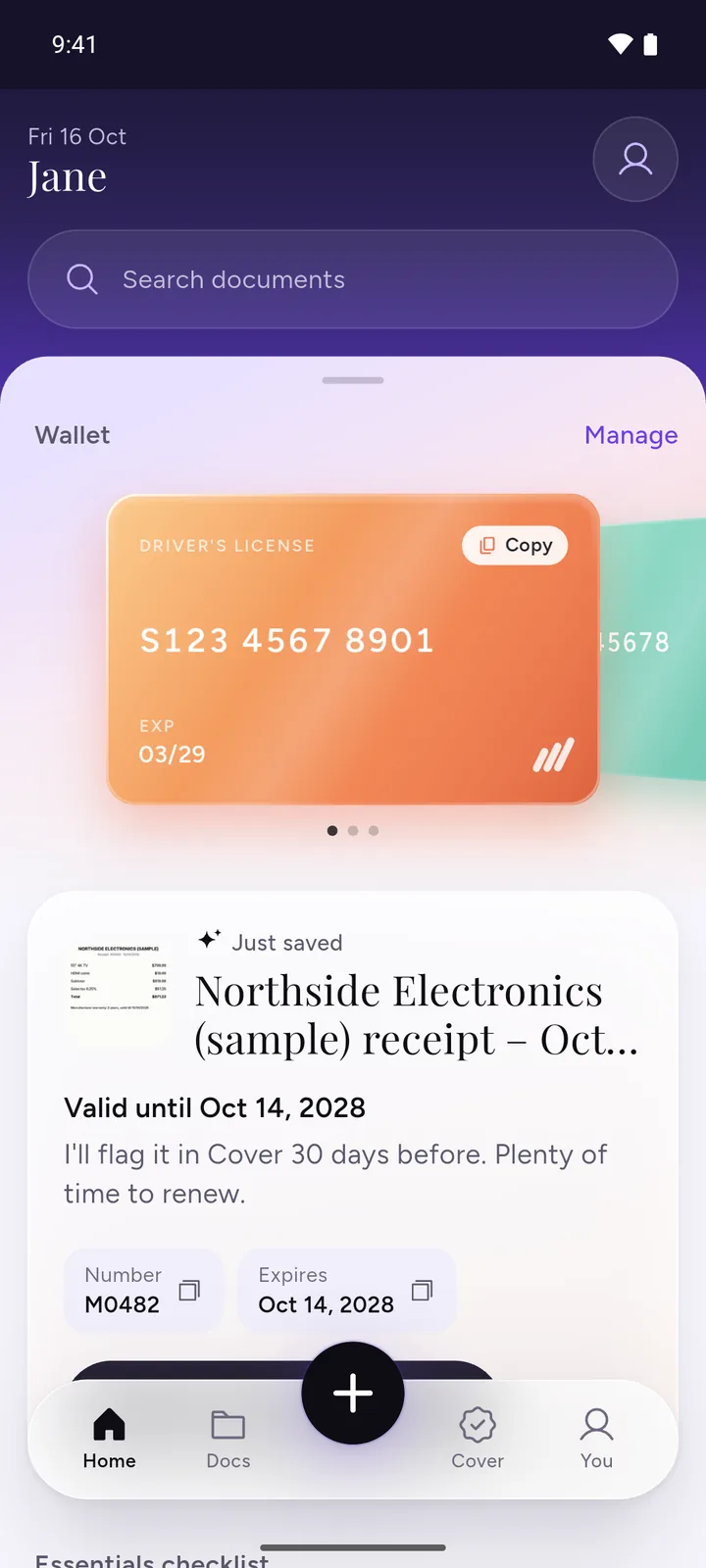
DocIt keeps a copy on your phone of the certificate you already have:
- Import the certificate PDF, or scan the paper certificate.
- Put it in a folder with the other papers admission and job forms ask for, such as mark sheets and your income certificate.
- Mark whose it is, so each family member's certificates stay apart. Your first family member is free.
- For upload forms, make a copy under 100 KB, 200 KB, 500 KB or 1 MB. Check the size the form asks for.
DocIt keeps a copy on your phone for convenience; it is not valid as the original. Offices that need the certificate will ask for the one your state issued. Files are encrypted on your phone. DocIt is free on Google Play, on Android.
Questions
Is a domicile certificate the same as a residence certificate?
Not always. The name and the rules depend on the state. Kerala, for example, lists domicile, nativity and residence certificates as three separate services, and gives them different validity. Use the exact name your form asks for, and ask the issuing office if you're not sure.
How long is a domicile certificate valid?
There is no single national rule. Kerala's e-District FAQ says its domicile certificate is valid for life. Other states set their own rules, and a college or employer may ask for one issued after a certain date. Read the form or notice you're applying under.
Is there a fee?
It depends on the state. Delhi's Department of Revenue says no fee is required. Check your own state's service portal for its fee.
How long does it take?
Delhi says certificates are issued in 14 days. Other states set their own service times, often listed on the service portal.
Can I get it online?
In many states, yes. Delhi, Kerala, Uttar Pradesh and Maharashtra all take applications through online service portals or service centres. Some states still verify your address in person before they issue it.
How do I check a domicile certificate is genuine?
Many state portals have a certificate verification page. Uttar Pradesh's e-District site has one, and says that if an issued certificate doesn't verify online, you should contact the district office with the original.
Is DocIt connected to any state portal?
No. DocIt is a document app. It isn't linked to any state government, tehsil, SDM office or e-District portal, and it can't issue or verify a certificate.
Related
- Birth certificate download in India: get the digital copy
- Aadhaar card address change: online, fee, documents and status
- Photo resize for online forms: exact KB and pixel size
- Important documents checklist
How we checked: on 5 November 2026 we read the domicile certificate page of Delhi's Department of Revenue, Kerala's e-District services list and FAQ, the e-District Uttar Pradesh home page and Maharashtra's Aaple Sarkar service list. The DocIt part was checked against the app's feature list for version 2.4.4. Rules, fees and documents differ by state and change over time, so check your state's portal before you apply.