You apply for a caste certificate or OBC certificate to the revenue office of your state or union territory: usually the tehsildar, taluk office or SDM, often through the state's online service portal. You'll need identity and address proof, and usually a family member's certificate or other documents that show your caste. Once approved, you download it from the same portal. In Delhi, there's no fee and certificates are issued in 14 days. Rules, names and validity differ by state, so check your state's portal first.
Who issues it
State and union territory governments issue caste certificates through their revenue departments. Who qualifies is set by the central and state lists and rules, and the issuing office checks each application. This page doesn't restate or judge those criteria. For them, read your state revenue department's page, or the notice of the job, admission or scheme you're applying for.
Names vary. Delhi lists SC/ST certificates and OBC certificates as separate services. Kerala's e-District FAQ says community certificates are issued for SC/ST and caste certificates for OBC. Maharashtra's portal lists a caste certificate and a non-creamy layer certificate as separate services.
How four states handle it
As their official pages read on 5 November 2026:
| State | Where to apply | Worth knowing |
|---|---|---|
| Delhi | SDM of your area or the Deputy Commissioner's office, or online. SC/ST and OBC certificates are separate services. | No fee. Issued in 14 days. A local enquiry is done for SC/ST certificates. |
| Kerala | Taluk office or village office, through e-District. A community certificate is for SC/ST; a caste certificate is for OBC. | Caste and community certificates: 3 years. Non-creamy layer certificate: 1 year. |
| Uttar Pradesh | e-District, at a CSC or Lokvani centre. | Aadhaar number is mandatory. Issued certificates can be verified online. |
| Maharashtra | Aaple Sarkar portal: "Caste Certificate" and "Non Creamy Layer" are separate services. | Check the portal for documents and fee. |
Sources: Delhi Department of Revenue, Kerala e-District FAQ, e-District Uttar Pradesh and Aaple Sarkar, Maharashtra. For other states, look for caste certificates on the state's e-District or service portal.
Documents state offices list
Delhi: SC/ST certificate
The Department of Revenue asks for:
- the application form, self attested
- an Aadhaar number, or a PAN card, passport, driving licence or voter card
- a copy of the SC/ST certificate of your father, brother, sister or another blood relative on your father's side
- a self declaration, if that relative's certificate was issued outside Delhi
- proof of your present address and proof of date of birth
If no one in the family has a certificate, two government servants who know you certify your caste, with copies of their ID cards. Delhi says a local enquiry is done in all cases, and for a married woman it covers the address before and after marriage. Documents can be self attested.
Delhi: OBC certificate
The OBC certificate page asks for the form, an Aadhaar number or other ID, a self declaration, proof of address, a copy of a paternal relative's OBC certificate if available, two attestations by an MP, MLA, councillor or gazetted officer, proof of residence in Delhi since 1993, and family income proof such as an ITR, salary slip or Form 16.
Kerala: caste certificate
Kerala's e-District FAQ lists an affidavit, any relevant document certifying caste, the ration card and a school certificate. Kerala checks the ration card number against its records, so you type the number instead of uploading a copy.
Uttar Pradesh
The e-District site says an Aadhaar number is mandatory for caste, income and residence certificates. You hand in the form with a passport size photo, a self declaration and copies of supporting documents at a CSC or Lokvani centre.
Step by step
- Find your state's service portal. Search for your state's name with "e-District", or start from the revenue department's website. Check the address ends in .gov.in or .nic.in.
- Pick the right service: SC/ST, OBC, or a non-creamy layer certificate if your state lists it separately and your form asks for it.
- Gather the documents your state lists. Delhi, for example, asks for a family member's certificate if one exists.
- Apply online, at a service centre or at the tehsil or SDM office. Note the application number.
- Answer the local enquiry or verification if your state does one.
- When it's approved, log in with your application number and download the certificate. Check every name and date on it.
Validity and dates
Validity is set by each state, and by the notice you're applying under. Kerala's FAQ, for example, gives 3 years for caste and community certificates and 1 year for a non-creamy layer certificate. Job and admission notices often name a format and a date the certificate must be issued after. Read that part of the notice before you apply, so you apply for the right certificate at the right time.
Watch out for look-alike sites and agents
Some private websites look like state portals, or offer a caste certificate for a fee without the state's checks. Only the state's revenue authority can issue one, after its own checks. A certificate that skips those checks isn't a real one. Before you type an Aadhaar number, an OTP or a payment detail, check that the address ends in .gov.in or .nic.in. If a service centre charges you, ask for a receipt that shows the official fee.
Keep it with your admission and job papers
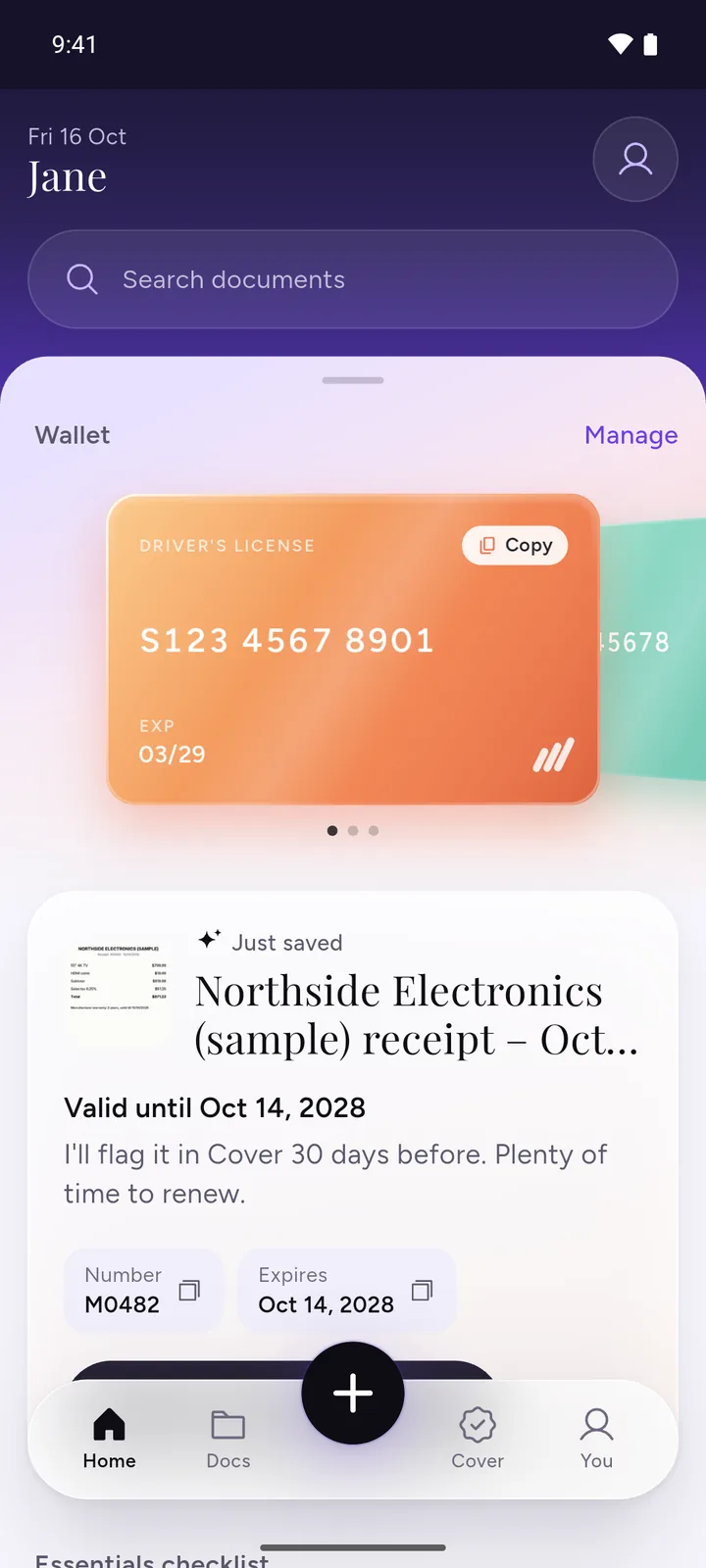
We make DocIt, so keep that in mind as you read this part. DocIt is an Android app for keeping documents on your phone. It has no link to any state government or service portal, and it can't issue or verify a certificate.
DocIt keeps a copy on your phone of the certificate you already have:
- Import the certificate PDF, or scan the paper certificate.
- If your state gives it a validity period, type the end date. Once reminders are on, DocIt reminds you 30, 7 and 1 day before. DocIt doesn't know any validity period on its own; it uses the date you save.
- Mark whose it is, so each family member's certificates stay apart. Your first family member is free.
- For upload forms, make a copy under 100 KB, 200 KB, 500 KB or 1 MB. Check the size the form asks for.
DocIt keeps a copy on your phone for convenience; it is not valid as the original. Offices that need the certificate will ask for the one your state issued. Files are encrypted on your phone. DocIt is free on Google Play, on Android.
Questions
Who can get a caste certificate?
That depends on the central and state lists and rules, and the issuing office decides each application. This page explains the process only. For the criteria, read your state revenue department's page or the notice of the job or admission you're applying for.
What is the difference between a caste certificate and an OBC certificate?
The names differ by state. In Kerala, for example, a community certificate is issued for SC/ST and a caste certificate for OBC. Delhi lists SC/ST certificates and OBC certificates as separate services. Apply for the one your form names.
How long is a caste certificate valid?
There is no single rule. Kerala's e-District FAQ gives 3 years for caste and community certificates and 1 year for a non-creamy layer certificate. Other states set their own periods, and a job or admission notice may ask for a certificate issued after a certain date. Read the notice you're applying under.
Can I use a state certificate for a central government job?
Check the job or admission notice. It says which certificate format, issuing authority and date it accepts. Follow it exactly, and ask the recruiter or institution if you're unsure.
How do I download my caste certificate?
Log in to the state portal where you applied, open your application with its number, and download the certificate once it's approved. Check every name and date on it before you use it.
How do I check a caste certificate is genuine?
Use your state portal's certificate verification page if it has one. Uttar Pradesh's e-District site does, and says that if an issued certificate doesn't verify online, you should contact the district office with the original. Delhi's revenue department also publishes a page of cancelled caste certificates.
Is DocIt connected to any state portal?
No. DocIt is a document app. It isn't linked to any state government, SDM office, tehsil or e-District portal, and it can't issue or verify a certificate.
Related
- Birth certificate download in India: get the digital copy
- Aadhaar card download: e-Aadhaar, password and PVC card
- Photo resize for online forms: exact KB and pixel size
- Important documents checklist
How we checked: on 5 November 2026 we read the SC/ST and OBC certificate pages of Delhi's Department of Revenue, Kerala's e-District services list and FAQ, the e-District Uttar Pradesh home page and Maharashtra's Aaple Sarkar service list. The DocIt part was checked against the app's feature list for version 2.4.4. This page explains the process in general terms. It doesn't say who qualifies; the issuing office decides. Rules, fees and documents differ by state, so check your state's portal before you apply.