
How it works
- Pick a tab: tax, or CTC to in-hand.
- Enter your income and what you claim.
- Compare the old and new regimes.
From the makers of these tools
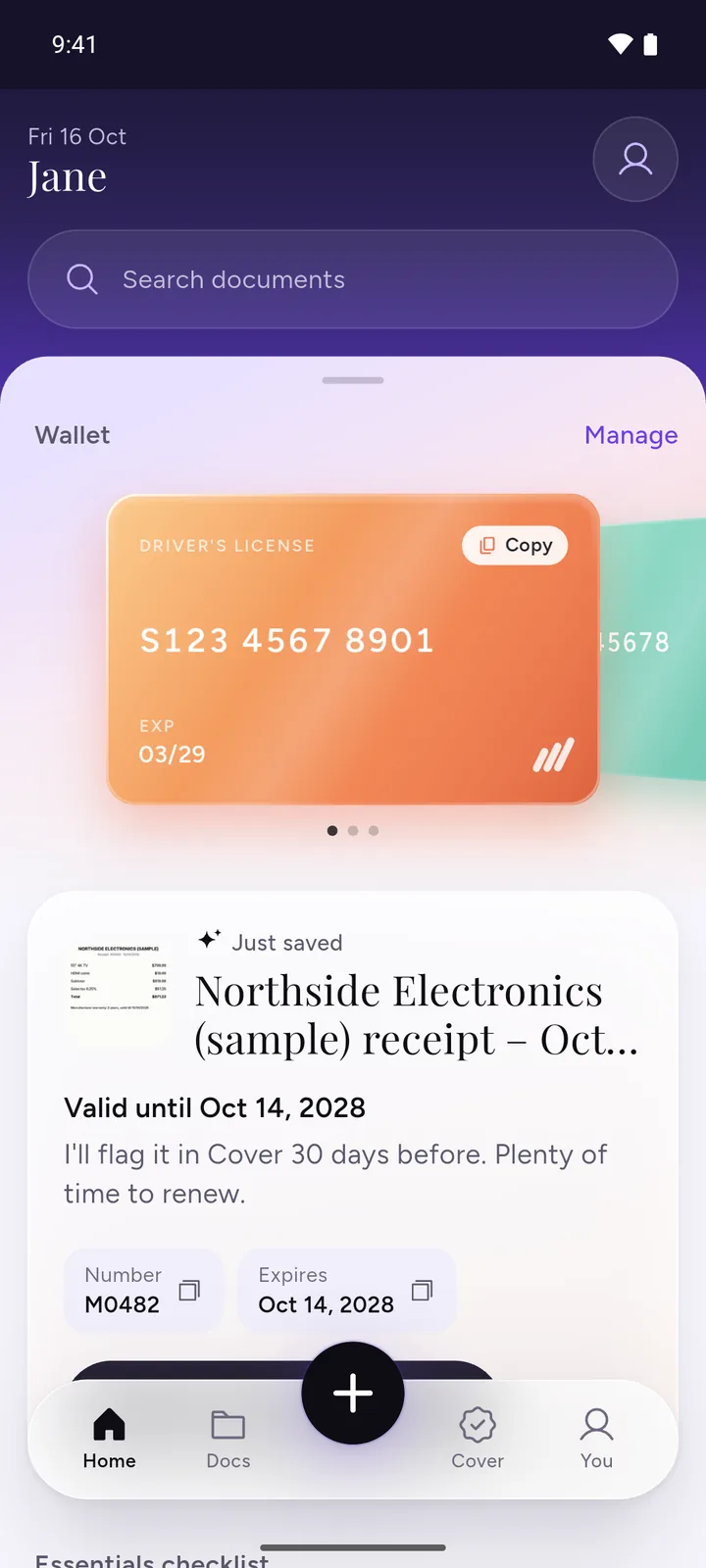
All your documents, safe on your phone
IDs, insurance, bills and warranties in one app, with a reminder before anything expires.
- ScanPoint your camera. It crops the page for you.
- RememberReminders 30, 7 and 1 day before expiry, once you turn them on.
- PrivateEncrypted on your phone. No ads, no sign-up.
 Download DocIt free
What's new in FY 2026-27
- A new law. This is the first year under the Income-tax Act, 2025, which calls it "tax year 2026-27". Sections have new numbers: 80C is now section 123, 80D is section 126 and the 87A rebate is section 156.
- No tax up to ₹12 lakh of taxable income in the new regime, thanks to a rebate of up to ₹60,000. Just above ₹12 lakh, marginal relief means your tax can't be more than the income above ₹12 lakh.
- Standard deduction on salary: ₹75,000 in the new regime, ₹50,000 in the old.
- HRA: 8 cities now count at 50%. Rule 279 adds Hyderabad, Pune, Ahmedabad and Bengaluru to Mumbai, Kolkata, Delhi and Chennai. Everywhere else is 40%.
- PF wage ceiling went up from ₹15,000 to ₹25,000 a month on 17 September 2026.
How the tax tab works
Enter your age, your salary for the year and any other income such as bank interest. Then add what you claim: 80C savings, health insurance, HRA exemption (there's a helper to work it out), home loan interest, your own extra NPS and your employer's NPS. Most of these count only in the old regime. Employer NPS counts in both. You get the tax under each regime, line by line, with the cheaper one marked and how much it saves you in a year.
How the CTC to in-hand tab works
This is a CTC calculator for your offer letter. Enter your yearly CTC, basic pay as a share of it, HRA as a share of basic and any variable pay. Choose how your employer pays PF, whether gratuity sits inside your CTC, and your professional tax. The tab splits the CTC into basic, HRA, special allowance, employer PF and gratuity, then takes off your PF, professional tax and income tax to show your monthly in-hand pay. Variable pay is shown on its own, after the extra tax it adds. Your in-hand pay appears under both regimes, so you can see which leaves more in your account.
How we work out the tax
- New regime (the default). Income minus a ₹75,000 standard deduction on salary and any employer NPS (up to 14% of basic). Slabs: nil up to ₹4 lakh, then 5%, 10%, 15%, 20% and 25% for each ₹4 lakh, and 30% above ₹24 lakh. A rebate of up to ₹60,000 means no tax up to ₹12 lakh of taxable income; just above that, the tax can't be more than the income above ₹12 lakh.
- Old regime (you choose it when you file). Income minus a ₹50,000 standard deduction, HRA exemption, professional tax, home loan interest (up to ₹2 lakh), 80C (up to ₹1.5 lakh), extra NPS (up to ₹50,000), health insurance (80D) and employer NPS (up to 10% of basic). Slabs: nil up to ₹2.5 lakh (₹3 lakh at 60, ₹5 lakh at 80), 5% to ₹5 lakh, 20% to ₹10 lakh, 30% above. No tax up to ₹5 lakh of taxable income.
- Then for both: surcharge of 10% above ₹50 lakh, 15% above ₹1 crore and 25% above ₹2 crore (37% above ₹5 crore in the old regime only), with marginal relief at each step, and 4% health and education cess.
How we work out in-hand salary
- Salary structure. Basic is your chosen share of the CTC. HRA is a share of basic. Employer PF is 12% of basic (or of basic up to ₹25,000 a month with the capped option). Gratuity is 15 days of basic for each year, a month counted as 26 days: about 4.81% of basic. What is left after those and any variable pay is the special allowance.
- Deductions from pay. Your own PF is the same amount as the employer's. Professional tax is what your state charges, at most ₹2,500 a year.
- In-hand pay. Fixed pay minus your PF, professional tax and the tax on it, divided by 12. Variable pay is shown separately, after the extra tax it adds.
These are estimates, not tax advice. They are for a resident individual; capital gains, business income and other special cases are left out, and your employer may split a CTC differently. The figures use FY 2026-27 (AY 2027-28) rules, called tax year 2026-27 under the Income-tax Act, 2025, which renumbered sections such as 80C (now 123), 80D (126) and 87A (156).
Not covered: capital gains, business income, non-residents, the ₹7.5 lakh yearly cap on what your employer puts into PF, NPS and superannuation, and the labour codes' 50% wages rule, which may change how much of your pay counts for PF and gratuity.
Filing season means hunting for documents. Keep your Form 16, rent receipts and investment proofs encrypted on your phone with DocIt, and its tax checklist shows which ones you still need. Free to download.
Sources
Every rate comes from an official source, checked on 2 November 2026:
- New regime slabs (Income-tax Act, 2025, section 202)
- Rebate up to ₹60,000 / ₹12,500 and its marginal relief (section 156)
- Standard deduction ₹75,000 / ₹50,000 and professional tax (section 19)
- Old regime slabs and surcharge (Finance Act, 2026, First Schedule, Part I-B)
- New regime surcharge capped at 25%, 4% cess, "no change in rates" (Finance Bill 2026 memorandum)
- Section 123 (old 80C) limit ₹1.5 lakh
- Employer NPS 14% / 10% and own NPS ₹50,000 (section 124)
- Health insurance limits (section 126, old 80D)
- Home loan interest ₹2 lakh (section 22)
- HRA exemption and the 8 cities at 50% (Income-tax Rules, rule 279)
- PF 12% (EPFO FAQs, September 2026)
- PF wage ceiling ₹25,000 a month from 17 September 2026 (PIB)
- Professional tax, Maharashtra, men's and women's slabs (MahaGST rate schedule, Schedule I entry 1)
- Professional tax cap ₹2,500 a year (Constitution, Article 276(2))
- Gratuity: 15 days of pay a year, month of 26 days (Payment of Gratuity Act, section 4(2))
Questions
Old vs new regime: which is better?
It depends on your deductions. The new regime has lower slab rates and a bigger standard deduction, but it drops most deductions, such as 80C, 80D, HRA and home loan interest. The old regime keeps them. If you claim a lot, the old regime can work out cheaper; if you claim little, the new one usually wins. Enter your numbers and the calculator compares both and marks the one that costs less.
Is income up to ₹12 lakh tax-free in the new regime?
Yes, if your taxable income is ₹12 lakh or less, the section 156 rebate (the old 87A) brings your tax to nil in the new regime. For a salaried person that means a salary of up to ₹12.75 lakh, after the ₹75,000 standard deduction. Just above ₹12 lakh, marginal relief applies: your tax can't be more than the income above ₹12 lakh. At ₹12,10,000 taxable, the tax is ₹10,000 plus 4% cess, so ₹10,400. This calculator doesn't cover capital gains.
What are the new regime tax slabs for FY 2026-27?
Nil up to ₹4 lakh, 5% from ₹4 to 8 lakh, 10% from ₹8 to 12 lakh, 15% from ₹12 to 16 lakh, 20% from ₹16 to 20 lakh, 25% from ₹20 to 24 lakh, and 30% above ₹24 lakh. The slabs are the same at every age. In the old regime: nil up to ₹2.5 lakh (₹3 lakh from age 60, ₹5 lakh from 80), 5% up to ₹5 lakh, 20% up to ₹10 lakh and 30% above. Both add 4% health and education cess.
What is the standard deduction for FY 2026-27?
₹75,000 a year in the new regime and ₹50,000 in the old, taken off your salary before tax. You don't need to invest or show proof for it. If your salary is less than that, the deduction is your salary. The calculator applies the right one to each regime.
Which cities count as metro for HRA?
Under rule 279, eight cities get the 50% limit: Mumbai, Kolkata, Delhi, Chennai, Hyderabad, Pune, Ahmedabad and Bengaluru. Everywhere else it's 40%. Your HRA exemption is the lowest of three amounts: the HRA you get, rent paid minus 10% of basic and DA, and 50% or 40% of basic and DA. HRA exemption counts only in the old regime.
What does CTC to in-hand include?
CTC is what your employer spends on you in a year. The calculator splits it into basic, HRA, a special allowance for the rest, employer PF, gratuity (about 4.81% of basic, if your CTC includes it) and any variable pay. Employer PF and gratuity don't reach your monthly pay. Your in-hand pay is fixed pay minus your own PF, professional tax and income tax, divided by 12. Variable pay is shown separately, after the extra tax it adds.
How is PF worked out?
Your employer puts in 12% of your basic and DA, and you pay the same 12% from your salary. The employer's part is inside your CTC but goes to your PF account, not your bank. Some employers count the full basic; others cap it at the PF wage ceiling, which went up from ₹15,000 to ₹25,000 a month on 17 September 2026. With the cap, each side pays up to ₹3,000 a month. Pick the option your offer letter uses. In the old regime, your own PF counts toward the 80C limit of ₹1.5 lakh.
How is professional tax worked out?
It depends on your state, and no state can charge more than ₹2,500 a year. Maharashtra is built in, at its slab rates: ₹2,500 a year once monthly pay is above ₹10,000 (₹200 a month, ₹300 in February), ₹175 a month between ₹7,501 and ₹10,000, and nil below that. In Maharashtra, women earning up to ₹25,000 a month pay nothing: tick "Woman employee" and the calculator applies that slab. For any other state, type the yearly amount from your salary slip. It lowers your in-hand pay, and in the old regime it also lowers your taxable income.
Why might my payslip differ from this?
Employers split a CTC in their own way, pay bonuses at different times and take tax each month based on the investments you declare. Some also add items this calculator doesn't model. Use the result as a close estimate and check your actual salary structure in your offer letter or payslip.
What do tax year, FY and AY mean?
FY 2026-27 is the year you earn the income, 1 April 2026 to 31 March 2027. The Income-tax Act, 2025 calls that year "tax year 2026-27". The older term, assessment year (AY 2027-28), means the year after, when the income is assessed. You'll still see all three, so this page shows FY 2026-27 (AY 2027-28). They all point to the same income.
Is this tax advice?
No. It's an estimate, not tax advice. It uses FY 2026-27 rules for a resident individual with salary and similar income, and every rate links to an official source below. For your return, check with your Form 16 or a tax professional.
Is my data sent anywhere?
No. The calculator runs in your browser. What you type isn't sent to us or anyone else, and nothing is saved, so it's gone when you close the page.
Related tools
- EPF calculatorEstimate your EPF balance at retirement from your basic + DA, with the ₹25,000 wage ceiling and yearly interest.
- Gratuity calculator (India)Estimate your gratuity and the tax-free part under the 2020 Code on Social Security.
- EMI calculatorWork out the monthly EMI on a home, car or personal loan, with total interest and a yearly table.